
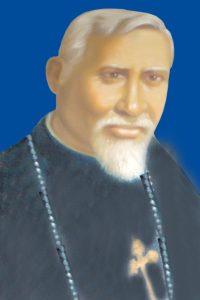
Bishop Louage was succeeded by German-born Father Peter Hurth, CSC, who was appointed only 18 days after the death of Bishop Louage. He had a brilliaKit career in the USA as an educator before being named bishop of Dacca. He was President of St. Joseph’s Col¬lege, Cincinnati and President of St. Edward’s University in Austin, Texas. He had a reputation in both the USA and E. Bengal as a man of great energy. Bishop Hurth was consecrated Sept. 16, 1894 at the Sacred Heart Church, Notre Dame, Indiana and left on the same day to start his trip to E. Bengal. When he arrived in Bengal there were only 15 priests, one Brother and seven Sisters. Bishop Hurth realised the great importance of education and concentrated on schools and catechists. He began building the present old St. Gregory’s High School building. It survived the great earthquake of June 12, 1897, though the cathedral church, whose construction was begun by the Benedictines, was laid waste. The bishop designed the new cathedral himself, but Fr. Fallize gave the solemn blessing in his absence (in Europe) on September 14, 1898.
The problems of the climate and the environment told on the later missionaries as on the earlier ones. Fr. AdolpheGaudon died on July 14, 1902 at .the tender age of 26 after being in the country only three years. He had come as a deacon and was ordained by Bishop Hurth on January 21, 1900. He suffered from TB and had caught a cold on his way to Akyab, dying in Chittagong of complications.’ ” Another young (29 or 31) French missionary, Fr. Leon Badier, CSC died of cholera in Gdurnadi March 31, 1909, only a few days after a Cathechist Sister had also died of cholera in Dacca. Father Badier had worked only six years in E. Bengal. He was ordained by Bishop Hurth in Chittagong November 19, 1905.”
The new civil Province of East Bengal and Assam was an-nounced in 1905. The capital was to be in Dacca and work there had already begun when Bishop Hurth celebrated a Solemn Mass on Oc¬tober 16, 1905 in honour of the event. Due to strong popular Hindu Bengali opposition (because the new province was predominantlyMuslirri), the division lasted only until 1911, when the two Bengals were reunited. But in 1946 the predominantly Muslim district of Sylhet was cut off from Assam and joined to the province of E. Bengal. Thus, Sylhet District became part of East Pakistan after the Partition of In¬dia in 1947.
Bishop Hurth resigned February 15, 1909. After leaving he was appointed bishop of Neuva Segovia, Vigan in the Philippines on December 12, 1910. He retired in 1926 and was named Titular Arch-bishop of Bosra, Assistant to the Pontifical Throne and a Count of the Holy See. He died in Manila on August 1, 1935 and was buried in Vigan. Fathers Sy Wyss and Walt Marks on their way to India in 1934 were probably the last community members to visit him. Father Clancy summarised his important work in a few words: “Bishop Hurth left behind a solidly established school system, suitable residences for his missionaries, flourishing mission centers and a spirit of alert progres-siveness.”